

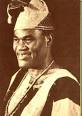
Hi everyone, what do you know about famous actor, and songwriter Hubert Ogunde? We have gone toake researches on him and brought it forward to our special audience so that they can know more about him.
Chief Hubert Adedeji Ogunde, D.Lit. was born on the10th of July 1916, He was a Nigerian actor, playwright, theatre manager, and musician who founded the first contemporary professional theatrical company in Nigeria, the African Music Research Party, in 1945.
Early Life.
Ogunde was born in Ososa, near Ijebu-Ode, Ogun State, Nigeria, to the family of Jeremiah Deinbo and Eunice Owotusan Ogunde. His father was a Baptist pastor and his maternal grandfather was a priest of Ifa, an African traditional religion. Ogunde briefly lived within the precincts of his grandfather’s compound and was exposed to Ifá, Ogun and many other traditional religious celebrations.Both the Christian and traditional religion of the Yoruba influenced his upbringing. He had his education between 1925 and 1932, attending St John School, Ososa, (1925–28), St Peter’s School, Faaji, Lagos, (1928–30) and Wasimi African School, (1931–32).
His first contact with performance art was as a member of Egun Alarinjo during his elementary school days. After completing his education, he worked as a pupil-teacher at St. John’s School, and was also church choirmaster and organist.
He later joined the Nigerian police force in March 1941 in Ibadan.In 1943, the police force posted him to the Denton Police Station, Ebute Metta, where he joined an African initiated church, the Church of the Lord (Aladura). In Lagos, he created an amateur drama group, the African Music Research Party, in 1945.
Like many of his theatre contemporaries, such as A. B. David, P. A. Dawodu, Layeni and G. T. Onimole, his theatre career began under the patronage of the Church. In 1944, he co-produced his first folk opera with G. B. Kuyinu, The Garden of Eden and The Throne of God, commissioned by the Lagos-based Church of the Lord (Aladura) founded by Josiah Ositelu. The performance was sanctioned to aid contributions to a Church building fund.
The folk opera premiered at Glover Memorial Hall with the chairman of the ceremony, Dr.Nnamdi Azikiwe, in attendance.The play incorporated realism and dramatic action in the acting, dancing and singing of the performers, separating it from the common Native Air Operas predominant in Yorubaland at the time.This was an innovation that contributed to making it a success.
At the request of the Alake of Abeokuta, Ogunde performed “The Garden of Eden” at the Ake Centenary Hall. Encouraged by the success of the play, he went on to write more operas. He wrote and co-directed three religious-themed plays: Africa and God (1944), a folk opera infused with Yoruba cultural themes than were non-existent in The Garden of Eden, Israel in Egypt (1945) and Nebuchadnezzar’s Reign and Belshazzar’s Feast (1945). In 1946, he resigned his post with the police to become a professional dramatist.
He changed the name to Ogunde Theater Party in 1947 and Ogunde Concert Party in 1950. Finally, in 1960, he changed it to Ogunde Theater, a name which remained until his death in 1990. He has been described as “the father of Nigerian theatre, or the father of contemporary Yoruba theatre”.
In his career on stage, he wrote more than 50 plays,most of which incorporate dramatic action, dance and music, with a story reflecting the political and social realities of the period. His first production was a church-financed play called The Garden of Eden. It premiered at Glover Memorial Hall, Lagos, in 1944. Its success encouraged Ogunde to produce more plays, and he soon left his job with the police force for a career in the theatre.
In the 1940s, he released some plays with political commentaries: The Tiger’s Empire, Strike and Hunger and Bread and Bullet. During the 1950s, he toured various Nigerian cities with his travelling troupe. In 1964, he released Yoruba Ronu, a play that generated controversy and earned him the wrath of Chief Akintola, premier of the Western Region.
The Ogunde Theater was banned in the Western Region of Nigeria for two years as a result. This ban was only revoked by the new military government of Lt. Col. F. A. Fajuyi on the 4th of February, 1966.
In the late 1970s, Ogunde was spurred by the success of Ija Ominira and Ajani Ogun, two pioneering Yoruba feature-length films, to co-produce his first celluloid film, Aiye, in 1979. He released Jaiyesimi, Aropin N’tenia and Ayanmo, feature-length films influenced by Yoruba mysticism, thereafter.
His first contact with performance art was as a member of Egun Alarinjo during his elementary school days. After completing his education, he worked as a pupil-teacher at St. John’s School, and was also church choirmaster and organist.
He later joined the Nigerian police force in March 1941 in Ibadan.[6] In 1943, the police force posted him to the Denton Police Station, Ebute Metta, where he joined an African initiated church, the Church of the Lord (Aladura). In Lagos, he created an amateur drama group, the African Music Research Party, in 194
Like many of his theatre contemporaries, such as A. B. David, P. A. Dawodu, Layeni and G. T. Onimole, his theatre career began under the patronage of the Church. In 1944, he co-produced his first folk opera with G. B. Kuyinu, The Garden of Eden and The Throne of God, commissioned by the Lagos-based Church of the Lord (Aladura) founded by Josiah Ositelu. The performance was sanctioned to aid contributions to a Church building fund.
He died on the 4th of April 1990
(Excerpt from Wikipedia)

